Monday, 23 November 2009

Social Networking

#9


The world in which we call 'social networking' seems to be growing more and more into our lives, whether this is a positive thing is up to you to decide but you can't disagree that an epidemic has spread.

Social networking is one of the best ways for word of mouth to start. Millions and millions of people log on to blogs and networking sites everyday such as Facebook and Twitter, each browsing their own interests, perhaps coming across something that catches their eye, they post it as a blog and suddenly 50 or more people know about it.

Advertisers have caught on to this growing fanatic and know that this is one way you can reach the public. But instead of just posting a blog about their latest product or deals many have came up with more innovative approaches.


The first time that Tmobile's adverts emerged on TV they perhaps didn't know that it would soon take them into the networking community. If you remember their adverts that asked passers by on the street what they would do if they had free texts for life, and one guy suggested that he'd text everyone he knew get them all together and have a massive jam. This guy was Josh Ward and T-mobile suggested that if he did create a 'super band' that they would like to follow him around and see how it goes. So it started! Josh set up a networking site on myspace. Allowed people to join him online and join the band, everyone told their friends to get online and join Josh's band. He posted a song that people could learn to sing or play on their instrument, he set up dates for tours around Britain and he managed to create this 'super band' that was once a just a suggestion on the advert for T-mobile...


...and now i am goin to partake in the act we call word of mouth by telling you to follow Josh's Band and see how he gets on!...
http://www.myspace.com/joshward84


This technique whether deliberate or not was a result of word of mouth because of the the media frenzy we live in. It shows how much potential the Internet provides in order to advertise yourself as well as products, which leads me on to one person who takes great advantage of this service. Johanna Basford.


Johanna is an artist/ illustrate/ print maker that designs hand drawn patterns and motifs all in black and white. Her work is intricate and very beautiful, you can see how much effort she puts in it; however to broaden her clientele she joined Twitter and created a fantastic networking way to do so. She had the idea of the Twitter Picture, it involved people suggesting lots of different thing for her to draw within a certain time limit - was about 3 days - and in the end she produced a fantastic print and huge recognition! She planned to sell 100 limited edition prints of the Twitter Picture and gave 25% off to those who had a suggestion drawn into it. What better way to entice buyers, they were a part of the design and would want to show it off, plus a discount! Bonus! She managed to advertise herself aswell as producing a profit, took a simple idea and the help of networking and she created a success.

It's encouraging to see the possibilities of networking approached in such a creative way. I think that there is still a lot of potential surrounding this world of networking that can help designers and those who are still students broaden their horizons pushing a little further every time so that we don't end up going backwards and misssing this opportunity.

Or maybe not? You might think that Bebo, Facebook, Myspace and Twitter are taking over our lives and eventually people will only communicate through the net, by leaving a comment on your blog. Lets hope we use it sensibly!

Thursday, 19 November 2009

Annotated Bibliography

#8

Assignment 3


Bibliography


COLLINS, Dan. 2007-2008. Social Networking for Learning Communities. Fate in Review. 29 27-39.

In this article, the potential of social networking for the 'foundation art studio' and how to make use of it is discussed. Explaining how the Internet and many of its features such as blogs can open up and highlight successful ways of networking. It strongly encourages the idea of social networking as it has its advantages to the art and design community.

FOGG, B.J. 2009. The Rules of Persuasion. RSA Journal. 155 (5538 June) 24-29.

In this journal article it highlights the idea that technology, such as social- networking, is becoming more and more persuasive. With this it allows you to pin point certain aspects of say your business, find out what is preventing it from growing and then apply your persuasion to the networking community.

GEER, J. G. GEER, J. H. 2003. Remembering Attack ADS. Political Behaviour. 25 69-95.

This article explores the reasons why certain methods of advertisement sticks more than others. Its takes a more political route into campaigning but explores the same principles as design advertising would. It talks about aggressive advertisement versus positive advertisement; comparing the success of each and whether one produces a better success than the other.

LOVETT, G. 2009. Google urges colleges to exploit digital design and social networking. Design Week. 24 (17) 4.

This journal article looks at research into social networking between colleges and universities. It will allow you to see at what research has already been looked at, in this case, research into finding ways of communicating with different audiences in a network of people. It talks about using networking sites, such as Facebook, to their full potential in order to network successfully.

NORMAN, D. 2004. Emotional Design. New York: Basic Books

This book explores the meaning of designs, how attractive things are perhaps better things. The idea that new things are not necessary a better design and that people respond better to designs that don't complicate our emotions. Good design is design that we can easily relate to.

SYLAVAIN, L. 2008. Reading Generation Next. Applied Arts. 23 (Mar-Apr) 40-53.

This article relates a lot to the idea that advertising has to be stick in order for it to work. It explores the idea that the world is changing and so are generations so ad companies must adapt. Finding ways to connect to their audience, primarily the younger generation, such as becoming a part of the social network that is taking over the Internet. This is how this generation communicates so getting on the same wave lengths is a start to getting through to their audience. Techniques develop once this fundamental idea is met such and interaction with the sites and networks which encourages word of mouth which then makes it successful and sticky!


Design Websites

Society of British Interior Designers
http://www.sbid.org/


Industrial Design Today
http://www.designboom.com/


New Designers Website
http://www.newdesigners.com/


WIRED Magazine
http://www.wired.com/


Wallpaper Website
http://www.wallpaper.com/interiors


Studio Unbound Twitter page
http://studiounbound.wordpress.com/design-on-twitter/


Other Websites

BBC News
http://www.news.bbc.co.uk/


Red Jotter
http://www.redjotter.wordpress.com/


Science News from New Scientist
http://www.newscientist.com/


YouTube - Always finding something interesting on there.
http://youtube.com/


LIFE Website
http://life.com/


Friday, 6 November 2009

Ambigious Furniture?

#7


Is a chair really a chair if you use it to stand on to change a light bulb or is a coffee table still a coffee table if you use it to rest your feet on? Does a piece of furniture become something different when it's function changes?

I'm currently exploring this idea of mis-use of furniture and how people really use there chairs and tables or any other piece of furniture. Anything from using a chair as a place to dump your clothes, how you physically sit on your chair, to perhaps using your bed as a trampoline! These ideas and insights into people's relationships with furniture will be interesting research for my project to design a piece of furniture and produce a finished piece.


Love this simple design by Philippe Malouin - The Hanger Chair, shows the subversion of furniture.


The Attitude Chair by Deger Cengiz is just another way to express how people really use their furniture - its quirky yet simple. Smart design.


The Todd Stool by Llot Llov, you know how hanging clothes up can be a pain, make use of your laziness and just dump them in the Todd stool making a comfy cushion! Clever!


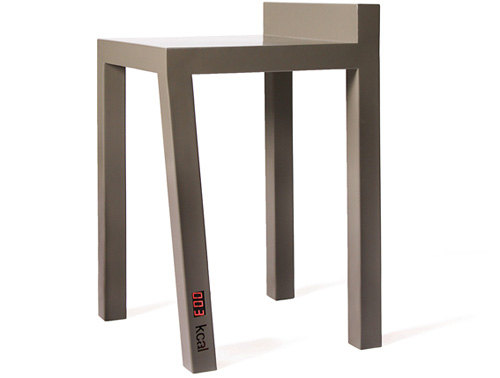
This ones just in for fun! The Constant Shaker by Alice Wang is part of the range of Chairs for the Dysfunctional. It counts your loss of calories as you fidget, Brilliant!


So if anyone has any comments or photos of how they use there furniture, that may be useful to me, would be much appreciated!

Tuesday, 3 November 2009

Juteopolis

#6


As our first project in second year we got to experience working as a group, this experience is the start to understanding the real world of design as we will find ourselves in many situations where we must learn to work as a team. In other words I found it very beneficial!

We were to design an exhibition space in the DCA Centrespace based on Juteopolis. Verdant Works were involved and although they are an exhibition of this topic we were to come up with a designers take on the theme.

We worked together to research the themes of Juteopolis (the history of the Jute industry in Dundee) and found that the interesting facts all seemed to point at the idea of connections in the industry. Everyone was connected and knew each other because of the jute. Families lived in close quarters, literally living on top of one another in the tenements. Neighbours became your family and your co-workers your best friends.

We took this idea and developed it further. The was an average number of people that stayed in one house - 8 - and at that there was sometimes only one room! This brought us to the idea of there being 8 objects in the room that connect to each other in some way. Over lapping and occupying each others space as it represents that idea in the tenements.

As part of the brief we were design the exhibition so that it travels and is sustainable as Jute is a sustainable material. So our 8 object became cubes of different sizes representing rooms, and each were constructed out of flat-pack cardboard. This made the cubes lightweight and easier to transport as some of the cubes reached 3000mm x 3000mm.

Each cubed displayed a different element of connection between the people of Juteopolis. Some had coloured jute attached from one to another and showed elements of weaving, as the connections between the people weaved in and out of different families. One box showed a projection of a workers hands signaling the "sign language" that they had for the noisy mills. This showed the connection between the workers as it was like having there own secret language.


Wednesday, 28 October 2009

The Stickiness Factor and IED

#5

Assignment 2


Brainstorming session...

This allowed myself and the group to discuss and share ideas and theories on the chapters context and relationship to Design, more importantly Interior design. I found that the discussion allowed us all to explore different ideas and sections of the book that perhaps we didn't feel were relevant but now do. It was interesting seeing how the two subjects interlinked and putting the book theories to practise.


Individual research...

I found the most interesting connections between the two subjects to mainly be how you or your business can be made "sticky". Through advertisement, research and networking Interior designers and, or their businesses can be sticky, but remembering that if its a bad design it won't be sticky, it's got to be wanted and needed! Stickiness can be reached on an advertising and social networking level; I found that logos, brands and networking sites have a lot of potential to help businesses become sticky. If research is done on what's sticky and what's not, designers can take advantage of the results and become contagious.


Monday, 19 October 2009

Bad Designers?

#4


Are biologist or environmentalists better designers than we students at DOJ? Are they more visually literate than designers "think" they are? Are those that solve world problems, research into cancer cures or try to make the environment greener, the real creative people of our society?

If we designers learn more about the world we live in design can become more than just a "nice" thing to look at - it can become innovative! Working with "non-designers" can widen our knowledge of the world and what people really need. A chair that's designer decided sleek and stylish are what the modern world needs did not think of the whole picture. Ok maybe one day it will be viewed through a glass case in a museum for its "chic" design but is that the real purpose of a chair - to be looked at? No. What about those who have been injured or those with mobile difficulty will they find the need for a hard plastic chair that's purpose is to simply look pretty?

I'm not trying to say that design shouldn't look good but instead it should be brought together with purpose to start to change the world. We have been placed in a great situation to bring together elements of design and innovation, we can think bigger and start to be truly creative. Designs can be more simple than you think to solve problems, remember we are not the scientists of today but that doesn't stop us working with them and bringing our creativity together with theirs.

Wednesday, 7 October 2009

The Tipping Point

#3


Assignment 1


I've recently read a book called the 'Tipping Point' by Malcom Gladwell; it takes you through the moments that cause the 'tipping point'; epidemics that at one point cross a line and spread rapidly into our lives.
He details every aspect of this idea thoroughly and repeatedly to reinforce the points he makes, I found this very useful as you begin to understand it more and more as the book progresses. I found myself getting so into it that I too was making everyday situations compare to the 'tipping point'. The subject made you think, thus teaching you the fundamentals to then continue to learn.

The Stickiness Factor is one of the three rules of epidemics and part of the book which I found most interesting. I think it was the subjects and examples Galdwell used; Sesame Street - I could relate to it, understand the concept so much more just because it was put into a language I once new. Basing the stickiness factor on kids TV programmes(Blue's Clue's, Sesame Street), for me, helped learning about the subject easier as I remembered the show and could put his reaserch into practise.
Not only did this chapter explain the stickiness factor, but it brought in elements of human behaviour into it which are so relevant to figuring out the stickiness of a product, advertisement or TV show.

The Mind map exercise broke down the book and also helped you memorise its context much more as you went over it in your head just to complete the map. Completed it also stands for future study notes and a starting point to begin looking into 'The Tipping Point' in so much more detail.